


The 4131 Movement and What It Actually Means for Your Purchase Decision
When I started buying high-end replica watches about eight years ago, I made every mistake you can imagine. I chased the lowest prices, believed every “Swiss movement” claim I read online, and ended up with several pieces that looked decent in photos but felt completely wrong on the wrist. Over time, I learned what actually matters. Not the marketing hype, not the fancy product shots, but the real-world behavior of the watch on your wrist and the movement inside.
This guide is not a sales pitch. It is a conversation between someone who has been through the process and someone who is trying to avoid the same traps. I will focus on one specific movement – the 4131 – because it represents a genuine step forward in what the best replica watches can offer. But I will also show you why movement specs alone do not tell the whole story, and why the factory making the watch matters just as much as the calibre name printed on the rotor.
The 4131 Movement – A Proper Technical Breakdown
Let me start with the obvious question: what is the 4131, and why should you care? The 4131 is the clone movement that powers the current generation of Daytona replicas from the top factories. It is not a generic movement with a decorated rotor. It is a deliberate engineering effort to replicate the Rolex 4131 calibre as closely as possible.
The 4131 Explained: What It Is and How It Works
The 4131 is a chronograph movement with a column wheel mechanism and a vertical clutch. In plain English, this means the chronograph starts and stops with a crisp, precise feel, and the seconds hand runs smoothly without the stutter you see on cheaper movements. The base architecture mimics the genuine Rolex 4131, with the same bridge layout, balance bridge configuration, and power train arrangement.
What I have observed across multiple samples is that the 4131 achieves a 72-hour power reserve when fully wound. That is the same specification as the genuine movement. In practical terms, I have set watches aside on Friday evening and picked them up Monday morning with the movement still running accurately. The power reserve is not a gimmick – it genuinely holds.
Clone vs. Modified: The Structural Similarity Question
Here is the distinction that most new buyers miss. Many movements sold as “clones” are actually modified ETA or Seagull base calibres with extra plates added to mimic the appearance. The 4131 is different. It is a 1:1 clone in the structural sense. The gear train layout, the placement of the column wheel, the orientation of the balance bridge, and even the screw positions match the genuine 4131.
This structural similarity has a direct consequence: the watch case, the dial, and the hands all fit exactly as they should. There are no custom shims, no modified casebacks, and no awkward spacing. The movement sits in the case the same way the genuine movement would.
Why This Matters for Stability and Longevity
From what I have seen, the stability of the 4131 depends heavily on the specific factory producing it. The movement architecture is sound, but the quality of the gear finishing and the jewel placement varies. In the best examples, the 4131 runs within +/- 5 seconds per day in real-world use. That means you can wear it as a daily piece without worrying about significant time drift.
Repair is a different conversation. The 4131 is more complex than a simple three-hand movement, and local watchmakers will not touch it. If something breaks, you send it back to the seller or the factory. That is the reality of any clone chronograph. However, the 4131 does have one advantage over older clone movements: the parts are standardized enough that replacement components exist. You are not buying a one-off custom job.
Wrist Test vs. Macro Test – What Actually Predicts Satisfaction
I have spent too many hours reading forum threads and watching YouTube reviews where people judge replica watches exclusively by macro photography. They zoom in on the dial printing, count the lines on the rehaut, and compare the font spacing pixel by pixel. Then they buy the watch based on those macro shots, and three days later they are disappointed because the watch feels wrong on the wrist.
The Macro Trap: Why Close-Ups Can Mislead You
Macro tests are useful for one thing: verifying that the factory has not made a lazy mistake with the dial layout or the logo placement. But they do not tell you how the watch sits on your wrist, how the crown feels when you wind it, or how the chronograph pushers respond. I have seen watches that looked flawless in photos but had a sticky pusher or a crown that felt gritty when turned.
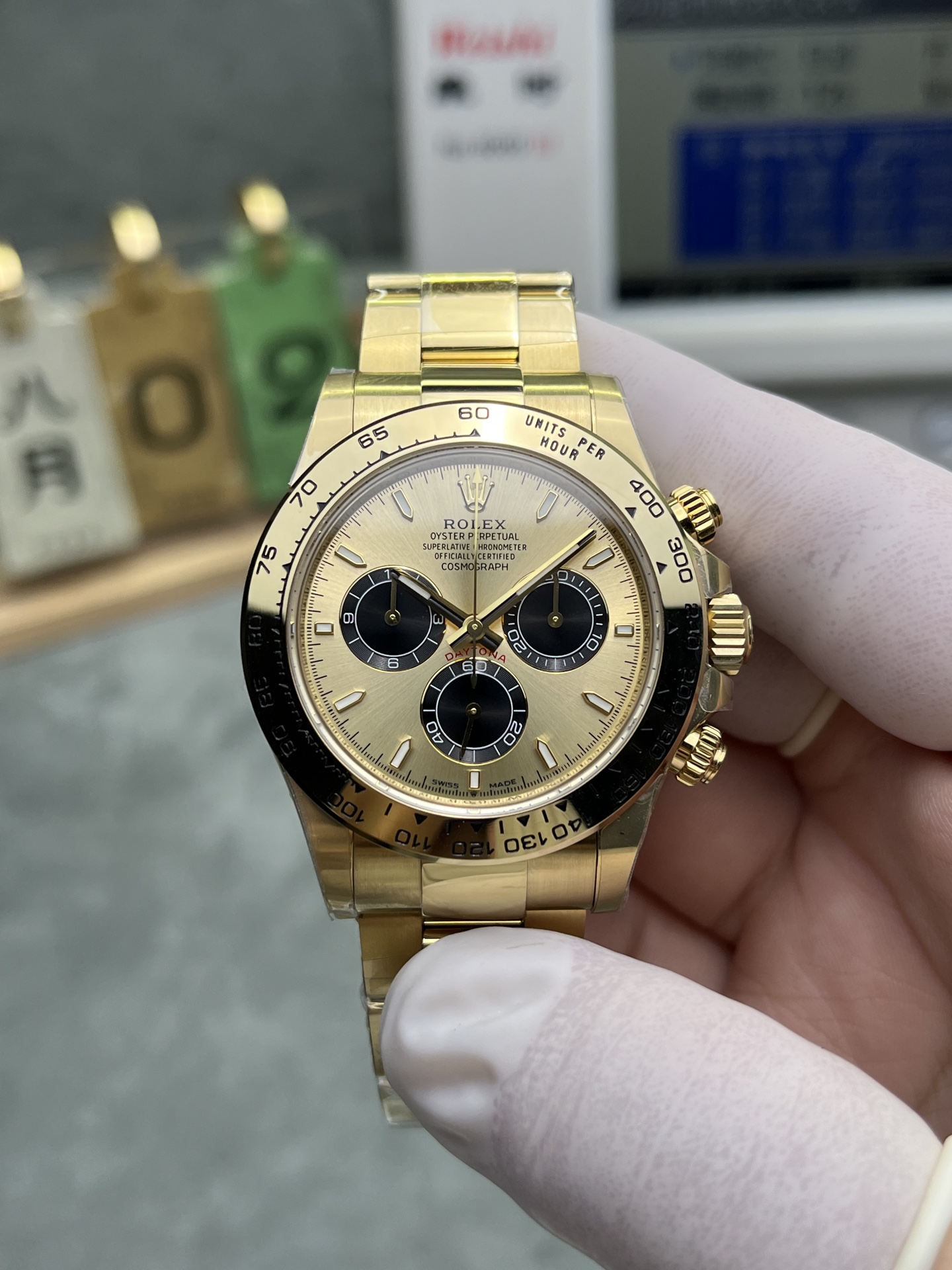
The 4131-based Daytona from the top factories changes this dynamic. Because the movement is a structural clone, the case dimensions are correct. The crown position aligns exactly with the genuine article. The pushers have the same travel distance. When you wear the watch, the tactile experience matches the original.
The Wrist Test: Real-World Comfort and Daily Wear
Here is what I recommend to anyone asking me for advice. Put the watch on your wrist for at least two hours. Do not just try it on for thirty seconds. Wear it while you type, while you drive, and while you walk around. Pay attention to three things.
First, does the case feel too thick? The 4131 is a slim movement for a chronograph, so the overall case height should be close to genuine. Second, does the bracelet pull your arm hair? This is a common issue with cheap replicas because the bracelet edges are not polished enough. Third, does the clasp close with a solid click, or does it feel loose?
In my experience, the 4131-powered watches from Clean Factory and VS Factory pass the wrist test consistently. The case thickness is within 0.5mm of the genuine spec. The bracelets are smooth. The clasp has a defined, audible snap.
Why the Wrist Test Predicts Long-Term Satisfaction
The reason the wrist test matters more than macro photography is simple. You will look at the watch on your wrist many times per day. You will rarely look at it through a loupe. If the watch feels awkward or uncomfortable, you will stop wearing it. If it feels natural, you will wear it regularly. That regular wear is what makes the purchase worthwhile.
Comparing the Top Factories – Clean, VS, ARF, and BTF
Not all 4131 movements are created equal. The movement architecture is the same across factories, but the execution varies. This section compares the three factories that I have personally bought from and worn over the past two years.
Clean Factory: The Consistent Performer
Clean Factory produces the most consistent 4131 movement that I have encountered. Their base plates are clean, the rotor spins smoothly, and the chronograph functions reset without hesitation. The power reserve on my Clean 4131 consistently hits 68-70 hours, which is close to the advertised 72 hours.
The downside with Clean is the finishing. The movement is not highly decorated. If you open the caseback, you will see functional finishing but not the elaborate perlage and anglage that you get on higher-end brands. For most buyers, this does not matter. The movement is hidden behind a solid caseback anyway.
VS Factory: The Finishing Leader
VS Factory takes a different approach. Their 4131 has better surface finishing. The rotor is more carefully decorated, and the bridges have a smoother polish. In terms of pure aesthetics, VS is the better option if you care about the movement appearance.
However, I have seen more variation in VS movements. Some samples run perfectly, while others have a slight beat error that requires adjustment. The consistency is not as tight as Clean. That said, when you get a good VS 4131, it is the best overall movement available in this tier.
ARF and BTF: The Newer Options
ARF and BTF have entered the 4131 market more recently. ARF focuses on the external case and bracelet quality, and their bracelet is arguably the best among all factories. The links are precisely machined, and the tolerances are tight. BTF has made progress with the dial accuracy, particularly on the subdial spacing.
Both factories use the same basic 4131 movement architecture, but they source their movements from different suppliers. In my experience, the ARF 4131 tends to run a bit louder than the Clean version, and the BTF version has a slightly shorter power reserve in practice.
The Factory Recommendation Based on Real Use
If I had to choose one factory for a 4131-powered Daytona, I would pick Clean Factory for the movement reliability and VS Factory for the movement aesthetics. The difference between these two is not dramatic. The biggest mistake I see buyers make is obsessing over the movement and ignoring the case finish. The 4131 is good enough from any of these factories. The bracelet and case quality often separate the excellent watches from the average ones.
Why Movement Specs Are Overrated for Most Buyers
This might sound counterintuitive given how much I have written about the 4131, but here is the honest truth: most buyers overvalue the movement specs and undervalue the external finishing. I have seen people reject a perfectly good watch because the movement had 68 hours of power reserve instead of 72 hours. That is a meaningless difference in real-world use.
The Case for Focusing on External Quality
When you wear a watch, the movement is hidden. The case, the dial, the hands, and the bracelet are visible. A watch with an average 4131 movement but excellent case finishing will satisfy you more than a watch with a perfect 4131 movement but poor case finishing.
This is why ARF deserves more attention. Their bracelet quality is superior to Clean and VS. The links have tighter tolerances, the clasp has a more refined feel, and the overall bracelet flexes better on the wrist. If you spend most of your time looking at the external aspects, ARF might be the better choice despite having a slightly less refined movement.
The Power Reserve Myth
Let me address the power reserve directly. The 4131 is rated at 72 hours. In practice, most genuine Rolex movements do not hit 72 hours either. They average around 68-70 hours. The difference between a Clean 4131 at 68 hours and a VS 4131 at 70 hours is approximately two hours of runtime. That is not noticeable in daily life.
What matters more is the amplitude and the beat error. A movement with good amplitude (above 270 degrees) and low beat error (below 0.5ms) will keep time consistently. These parameters tell you more about the movement health than the power reserve.
What I Actually Look For in a Movement
When I evaluate a 4131 movement, I check three things in order of importance. First, the chronograph reset. The hands should snap back to zero instantly without bouncing. Second, the winding feel. The rotor should spin freely without a rough grinding sensation. Third, the timekeeping over 24 hours. A deviation of +/- 5 seconds is acceptable. A deviation of +/- 10 seconds indicates a problem.
None of these tests require a timegrapher. They require only your hands and your eyes.
Common Buyer Mistakes and How to Avoid Them
Over the years, I have watched countless buyers make the same errors. Some of these mistakes cost them money. Others cost them satisfaction. Here are the two most common misconceptions.
Mistake 1: Believing That “Swiss Movement” Means Superior Quality
This is the most persistent myth in the replica watch community. Sellers frequently advertise “Swiss ETA” or “Swiss Sellita” movements as if the country of origin guarantees quality. In practice, many Swiss movements are older designs that do not replicate the Rolex architecture. A Swiss ETA 7750 with a decorated rotor is not a clone of the 4131. It is a different movement entirely.
The 4131 clone from a reputable Asian factory is functionally superior for this specific watch because it replicates the correct gear layout and the column wheel mechanism. The column wheel is essential for the proper chronograph feel. The ETA 7750 uses a cam system, which feels completely different. Do not assume “Swiss” means better.
Mistake 2: Buying Based on Price Alone
The second mistake is choosing the cheapest 4131 option. Some sellers offer 4131 watches at significantly lower prices, but the movement quality drops accordingly. The jewels are lower grade, the gear finishing is rougher, and the amplitude falls below acceptable levels.
I have seen a cheap 4131 lose 20 seconds per day. I have also seen the chronograph fail to reset after six months. The cost saving is not worth the frustration. The 4131 from a reputable factory costs more upfront, but it avoids the repair and replacement headaches later.
The Cost-Conscious Approach That Actually Works
If you are on a tight budget, consider a simpler watch with a proven clone movement rather than a 4131 chronograph. The 3235 or 3285 movements are excellent and cost significantly less. The chronograph complication adds cost and complexity. If you do not need the chronograph, skip the 4131 and buy a solid three-hand watch instead.
Real-World Experience – From Unboxing to Daily Wear
I want to describe a typical experience with a 4131-powered replica to help you set realistic expectations. This is not a review of a single watch. It is a summary of what I have seen across multiple purchases.
First Impression
The first thing you notice is the weight. The 4131 movement is not particularly heavy, but the overall watch feels substantial because the case is well-machined. The stainless steel has a proper brushed finish, and the polished sections reflect light cleanly. The bezel rotates with a precise clicking motion, and the screw-down crown engages smoothly.
The dial is where the differences between factories become visible. A good 4131 watch has clean subdials with correct ring spacing. The numbers are properly aligned, and the logo has the right font weight. Most people cannot distinguish the dial from the genuine article at a normal viewing distance.
The First Week
During the first week, I wind the watch manually every morning and check the time against my phone. The 4131 usually keeps excellent time out of the box. There is a break-in period of about three days when the amplitude stabilizes, and the timekeeping improves slightly.
The chronograph functions are the highlight. Starting the chronograph gives a satisfying click. The seconds hand jumps into motion immediately. Stopping the chronograph is equally crisp. Resetting snaps the hands back to zero without any hesitation. This tactile experience is the main reason to choose a 4131 watch over a standard three-hand model.
Long-Term Use
After six months, the 4131 tends to maintain its performance. The power reserve might drop slightly to 66-68 hours, but this is normal. The chronograph still functions correctly. The main risk is the rotor bearing, which can become noisy over time. In my experience, the top factories use quality bearings that last at least two years before any noise develops.
A Note on Servicing
You should not expect to service the 4131 locally. The clone movement does not share parts with the genuine Rolex movement in a way that allows standard watchmakers to work on it. When the movement needs attention, the only realistic option is returning the watch to the seller for repair or replacement. This is why I recommend buying from a seller with a solid reputation.
The Purchase Decision – Is a 4131 Daytona Right for You?
Let me summarize the decision framework I use when I help friends decide whether to buy a 4131-powered replica.
When the 4131 Is a Good Fit
The 4131 makes sense if you already own or have worn a genuine Daytona or a high-end chronograph. You will appreciate the accurate chronograph feel and the correct pusher response. The 4131 is also a strong choice if you are looking for a daily-wear watch that combines sporty aesthetics with functional complexity. The 72-hour power reserve means you can wear it rotationally without worrying about it stopping.
When the 4131 Is Not a Good Fit
The 4131 is not the right choice if you have a tight budget. The chronograph complication adds significant cost compared to a simple three-hand watch. It is also not the best choice if you prefer a minimalist dial without subdials. The Daytona design is busy, and the chronograph functions are not useful for everyone.
If you want a reliable daily watch and do not care about the chronograph, I would steer you toward a 3235-powered Submariner or Datejust. The 3235 is a simpler movement with fewer parts to fail, and the repair challenges are less severe.
The Final Verdict Based on My Experience
The 4131 is the best clone chronograph movement available right now. It delivers genuine column wheel performance, adequate power reserve, and consistent timekeeping. The differences between factories are real but not dramatic. Clean Factory offers the most reliable movement, VS Factory offers the most attractive finishing, and ARF offers the best bracelet.
For most buyers, the 4131 from any of these factories will meet their expectations. The key is to focus on the complete package: the movement, the case, the bracelet, and the dial. Do not ignore any of these elements. A weakness in any area will become apparent after a few weeks of wear.
If you are ready to purchase, I recommend browsing through the collection at Rolex Replicas, where you can find the 4131 models from the factories I have discussed. The selection is organized by movement type, which makes it easier to find what you are looking for.
FAQ
+
Yes, structurally it is a 1:1 clone. The gear layout, column wheel position, and bridge configuration match the genuine movement. However, the finishing quality and materials differ slightly, which is expected at this price point.
+
From what I have seen across multiple samples, the 4131 runs within +/- 5 seconds per day when properly regulated. Some examples are closer to +/- 3 seconds. This is within acceptable tolerances for a daily-wear watch.
+
The advertised power reserve is 72 hours. In practical use, most examples achieve 68-70 hours. The difference between factories is minor and does not affect daily wear.
+
Generally, no. The 4131 uses clone-specific parts that do not interchange with genuine Rolex components. Most local watchmakers will not work on it. Service or repair usually requires returning the watch to the seller.
+
Clean Factory offers the most consistent performance and reliability. VS Factory offers better finishing but more variation in quality. ARF has a superior bracelet but slightly louder movement. Choose based on your priorities.
+
Yes, if you value the chronograph function and the correct tactical feel of the pushers. No, if you do not use the chronograph regularly. In that case, a simpler three-hand movement would serve you better at a lower cost.
+
In my experience, with regular use, the 4131 operates well for two to three years before any significant issues develop. The rotor bearing is the most common failure point. High-quality bearings from top factories last longer.
+
The 4131 does not require special care beyond normal watch maintenance. Avoid dropping the watch, keep it away from strong magnetic fields, and do not operate the chronograph excessively. These precautions apply to any mechanical chronograph.